
Branded residences in Dubai have moved from a niche luxury product to one of the most closely watched segments of the emirate’s prime market. A branded residence pairs a private home with the name, design language, and service standards of an established hotel, fashion, or design brand. According to Knight Frank (2025), the number of branded developments worldwide is set to rise by 59% in the five years to 2029, and Dubai sits among the handful of cities where the model has become close to standard at the top of the market.
For high-net-worth and non-resident Indian investors weighing an address abroad, the appeal is clear: a recognised name, hotel-grade service, and an asset that aims to hold its value across cycles. 4 Estates is a private property advisory firm curating premium and luxury residential investments across India, UAE, and the United Kingdom for HNIs, UHNIs, and NRIs. This guide sets out what a branded residence in Dubai is, how the segment is performing, what the premium buys, how the Golden Visa connects to it, and the cross-border funding routes Indian investors use.
Key Takeaways
- A branded residence pairs a private home with the identity and service standards of a hotel, fashion, or design brand, usually under a long-term licensing and management arrangement.
- Knight Frank (2025) reports that more than 80% of branded residence projects globally are delivered by luxury hotel operators, which shapes the service model buyers should expect.
- Dubai’s prime market remains strong: residential values across the city’s ten prime neighborhoods averaged AED 3,767 per sq ft in Q3 2025, up 8.4% year on year, according to Knight Frank (2025).
- A qualifying property of at least AED 2 million can support a ten-year renewable UAE Golden Visa, per the Dubai Land Department, which makes many branded residences eligible.
- 4 Estates advises HNI and NRI clients on branded residence selection on a 0% commission advisory model, with compensation funded by the developer rather than the client.
- For the wider context on cross-border allocation, see our NRI property investment guide.
What Are Branded Residences in Dubai?

A branded residence is a home sold under the name of an established brand, most often a luxury hotel operator, but increasingly a fashion house, a design studio, or an automotive marque. The brand lends its identity, its design language, and in most cases its service and management standards. Residents typically gain access to hotel-style amenities such as concierge, housekeeping, wellness facilities, and food and beverage, often with the option to place the unit into a rental or hotel programme when it is not in use.
Dubai’s appeal for this model rests on three structural factors: a deep pool of international wealth, freehold ownership for foreign buyers in designated zones, and a development pipeline geared to the luxury end. Knight Frank (2025) notes that branded residences have become close to ubiquitous in cities such as Dubai, where hotel brands, designers, and even sports and automotive names compete for buyers’ attention.
Treated correctly, real estate of this kind is best understood as an asset class within a wider portfolio rather than a single trophy purchase. Holding real estate as an asset class, alongside equities and other allocations, is the lens this guide applies to every Dubai decision.
What the brand actually guarantees
The brand on the door is a promise about standards, not an automatic guarantee of returns. The strength of that promise depends on the operator’s track record, the length and terms of the management agreement, and how service charges are structured. These details separate a durable branded asset from a name applied loosely to ordinary stock, a point explored in our guidance on why choosing the right project matters.
How Is Dubai’s Branded Residence Market Performing in 2026?
Dubai’s prime residential market entered 2026 from a position of strength. Knight Frank (2025) recorded a 10% year-on-year rise in average residential values at the end of the third quarter of 2025, extending an unbroken run of quarterly growth that began in late 2020. The same review logged a record 56,854 home sales in the third quarter alone, with a combined value of US$31.8 billion.
The top of the market, where branded residences concentrate, has been particularly active. According to Knight Frank (2025), 103 homes sold for more than US$10 million in the third quarter of 2025, 24% ahead of the same period a year earlier, and Dubai recorded 435 sales above US$10 million across 2024, making it the world’s busiest market in that bracket. Among prime neighbourhoods, Palm Jumeirah posted the highest annual apartment price increase, at 31%.
Looking ahead, Knight Frank (2025) expects prime Dubai prices to rise by around 3% in 2026, a more measured pace than recent years. For an investor, the signal is a maturing market with genuine end-user demand rather than a speculative spike, which tends to favour assets with defensible, brand-backed positioning. The table below sets out how branded and non-branded luxury stock compare on the factors that matter most.
Branded versus non-branded luxury residences in Dubai
| Factor | Branded residence | Non-branded luxury residence |
| Purchase price | Meaningful premium over comparable stock (Knight Frank, 2025) | Lower entry price for similar floor area |
| Service and amenities | Hotel-grade, to the brand standard | Building-dependent, owners’ association |
| Design and finish | Brand-specified and consistent | Developer or owner discretion |
| Rental or hotel programme | Often offered through the operator | Owner-arranged or none |
| Service charges | Typically higher for managed service | Generally lower |
| Resale positioning | Supported by brand recognition and scarcity | Driven by location and condition |
What HNIs and NRIs Should Weigh Before Investing
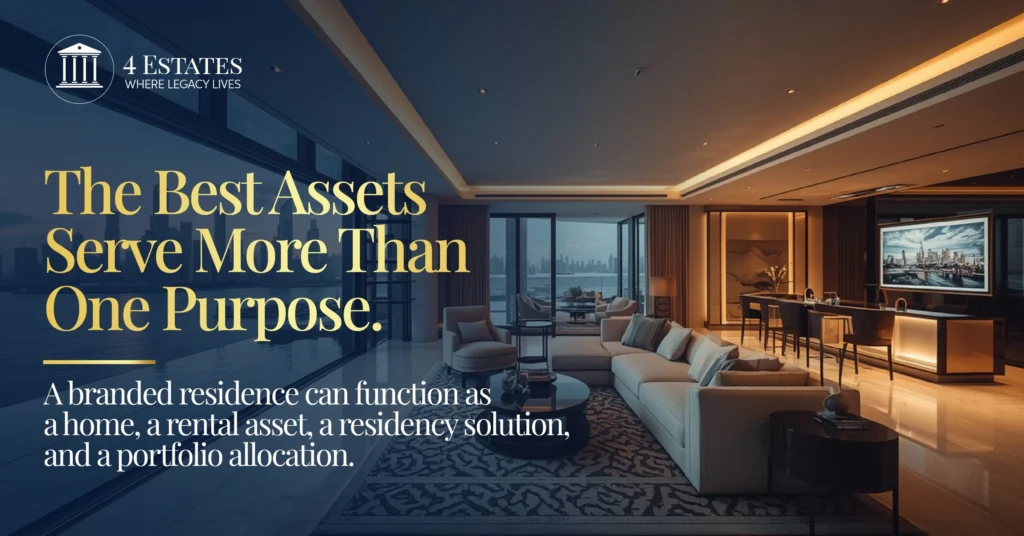
For an NRI building exposure across India, the UAE, and the UK, a branded residence in Dubai can serve more than one purpose: a usable second home, a managed rental asset, and a currency-diversified holding. The case for it rests on a few advantages.
First, predictability of standards. Because more than 80% of branded projects globally are run by hotel operators (Knight Frank, 2025), buyers are paying for a service culture refined over decades. Second, the prospect of capital preservation: scarcity at the top of the Dubai market, combined with brand recognition, tends to support values through cycles, though no asset is immune to them. Third, convenience for an absentee owner, since management, maintenance, and rental handling can sit with the operator.
The premium is the central question. Knight Frank (2025) observes that buyers are willing to shoulder substantial premiums for these residences, and that willingness should be tested against the specifics of each scheme. A premium is justified where the brand, the location, and the service genuinely lift long-term demand. It is harder to justify where a name has been applied without depth.
This is where a 0% commission advisory model matters to the investor. Because 4 Estates is compensated by the developer rather than by the client, the advice on whether a given premium is worth paying carries no transactional pressure on the buyer’s side. Clients pay nothing; the firm is funded through developer-partnership arrangements. The same discipline applies to the curated Dubai properties presented to clients.
Branded Residences and the UAE Golden Visa

For many Indian investors, residency is part of the appeal. The UAE Golden Visa offers a ten-year renewable residence permit to property investors, and many branded residences clear the threshold comfortably. According to the Dubai Land Department (2026), an investor who owns one or more properties with a total purchase value of at least AED 2 million can apply for the ten-year renewable permit, with mortgaged property eligible where a bank letter confirms the qualifying amount. The UAE Ministry of Economy and Tourism (2026) sets out the same AED 2 million floor at the federal level, with the property wholly owned by the investor.
The visa allows holders to sponsor a spouse, children, and parents, and does not impose a minimum-stay requirement, which suits cross-border families who divide their time across markets. For an NRI weighing Dubai against other bases, the residency dimension can be as material as the yield.
How Do Indian Investors Fund a Dubai Branded Residence?
Funding routes differ sharply by residency status, and getting this right is a FEMA-compliance matter, not a detail. For a resident Indian, the Reserve Bank of India’s Liberalised Remittance Scheme permits remittance of up to US$250,000 per individual per financial year, a ceiling in force since 2015, for permitted purposes that include the acquisition of immovable property abroad. A family of resident individuals can pool their separate limits, subject to the scheme’s conditions.
For an NRI, the position is different. The Liberalised Remittance Scheme does not apply. NRIs fund overseas purchases through their own foreign earnings and the NRE, NRO, and FCNR account framework rather than the resident remittance route. Applying the wrong route can create a problem under the Foreign Exchange Management Act, so the structure should be confirmed before any commitment. A double taxation avoidance agreement between India and the UAE further shapes how rental income and gains are treated across the two jurisdictions.
Currency is the quieter consideration. A Dirham-denominated asset gives an Indian investor a currency-hedged allocation against rupee movement, which is part of why diversification across India, the UAE, and the UK appeals to globally mobile families.
Due Diligence Before You Commit

A branded name does not remove the need for scrutiny. Before committing to a branded residence in Dubai, the essentials to verify include:
- The brand agreement: who holds the licence, how long it runs, and what happens to the residence’s status if the brand exits.
- The operator’s track record: delivered projects, service consistency, and reputation in the relevant category, whether hospitality, design, or another.
- Service charges: the per-square-foot rate, what it covers, and how it has moved over time, since managed service carries a recurring cost.
- The rental or hotel programme terms: revenue split, owner-use restrictions, and management control.
- Title, escrow, and developer registration with the Dubai Land Department, including the project’s status on the official register.
- The premium: how the asking price compares with non-branded stock of similar quality in the same district.
The same care applies in any market: our note on the common mistakes to avoid when investing sets out where buyers most often go wrong. 4 Estates is a private property advisory firm curating premium and luxury residential investments across India, UAE, and the United Kingdom for HNIs, UHNIs, and NRIs, and this checklist is the starting point of every Dubai engagement.
The 4 Estates Perspective

A branded residence in Dubai can be an excellent holding for the right investor: someone who values managed service, brand assurance, and a currency-diversified asset, and who buys with a clear view of the premium and the agreement behind it. It is less suited to a buyer chasing the lowest entry price or the highest headline yield.
As a private property advisory firm curating premium and luxury residential investments across India, UAE, and the United Kingdom for HNIs, UHNIs, and NRIs, 4 Estates operates as a Private Office for Indian wealth moving across Mumbai, Dubai, and London, structured around portfolio-allocation thinking rather than single-asset sales. Each Dubai recommendation is weighed as one position within a wider portfolio, alongside holdings in India and the UK, with the brand premium and the management terms tested on the client’s behalf. For investors building cross-border exposure, our cross-border property advisory resource sets out how these markets fit together.
The most useful next step is not a viewing but a conversation about objectives, residency plans, and how a Dubai asset would sit within everything else you hold. Begin with a conversation, not a listing.
Frequently Asked Questions
What is a branded residence in Dubai?
A branded residence in Dubai is a home sold under the name of a hotel, fashion, or design brand that supplies its identity, design standards, and usually its service and management. Knight Frank (2025) reports that more than 80% of such projects globally are run by luxury hotel operators. 4 Estates advises clients across Dubai’s branded segment.
Beyond the name, the value rests on the operator’s track record, the length of the management agreement, and how service charges are set. A strong branded residence pairs a credible operator with a prime location and clear agreement terms, which together support long-term demand.
Are branded residences in Dubai a good investment for NRIs?
Branded residences can suit NRIs who want a managed, currency-diversified asset rather than the cheapest entry price. Knight Frank (2025) recorded a 10% year-on-year rise in Dubai residential values at the end of Q3 2025, with prime neighbourhoods averaging AED 3,767 per sq ft. Suitability depends on the premium and the agreement.
Can a branded residence in Dubai qualify for the UAE Golden Visa?
Yes. A property with a total purchase value of at least AED 2 million can support a ten-year renewable UAE Golden Visa, according to the Dubai Land Department (2026), and many branded residences exceed that threshold. Mortgaged property qualifies where a bank confirms the required amount has been met.
How can an Indian resident legally pay for property in Dubai?
A resident Indian can fund a Dubai purchase under the Reserve Bank of India’s Liberalised Remittance Scheme, which permits up to US$250,000 per individual per financial year, a ceiling in force since 2015, for permitted purposes including immovable property abroad. NRIs cannot use this route.
What should I check before buying a branded residence in Dubai?
Before buying a branded residence in Dubai, verify the brand licence and its duration, the operator’s track record, the service-charge structure, any rental-programme terms, and the developer’s registration with the Dubai Land Department. The premium over comparable non-branded stock is the final commercial test.
How much premium do branded residences in Dubai command?
Branded residences in Dubai command a meaningful premium over comparable non-branded homes, and Knight Frank (2025) notes that buyers are willing to shoulder substantial premiums for the brand, design, and service. The exact figure varies by project, brand strength, and location, so it should be assessed case by case.